The hidden architecture behind
enterprise voice agents.
The conversation is the interface. It is not the system.
Spend a few minutes watching product demos for enterprise voice AI and you'll notice they all tell the same story. A customer asks a question, the agent understands it, and a response comes back almost instantly. It's a neat mental model because it reduces the system to something familiar: a conversation.
The problem is that the conversation isn't the system. It's just the interface.
The moment an enterprise deploys a voice agent, they're doing far more than adding AI to a phone line. They're connecting a language model to customer records, payment systems, calendars, internal APIs, and every other system the agent needs to do its job. By the time a customer hears a response, the agent may have already searched for context, retrieved memory, decided which tools to use, updated business records, and triggered actions across multiple systems.
That's a very different architecture from the one most people imagine. It's also why the conversation around voice AI security often feels incomplete. We're still treating the model as the thing that needs securing, when the model is only one component in a much larger runtime.
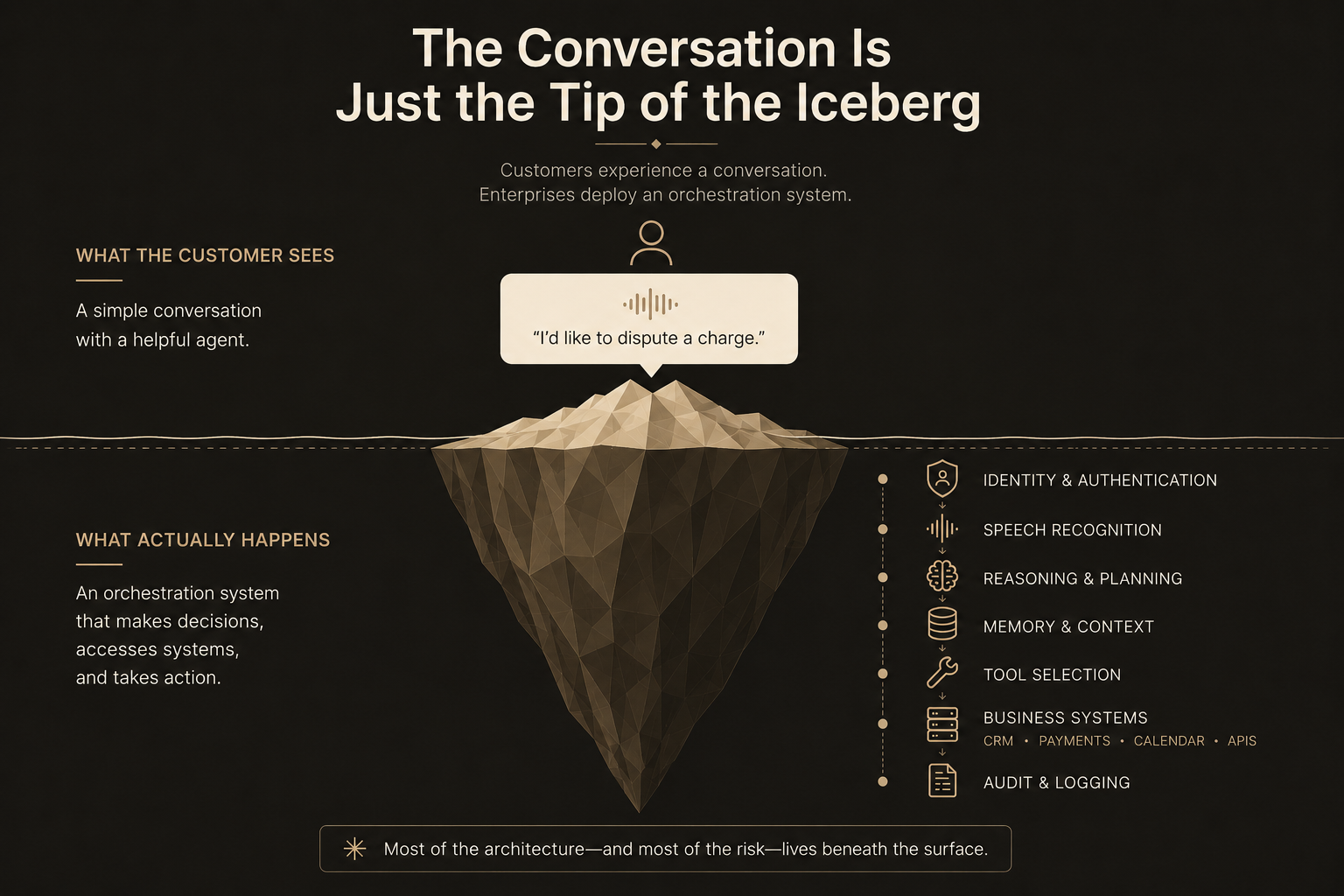
The easiest way to see the difference is to follow a single customer request from beginning to end.
The conversation is the smallest part of the system
Imagine a customer calls their bank to dispute a charge.
To the customer, it's one interaction. They explain the problem, answer a few questions, and ask for a refund. If the experience is good, it feels like they're talking to a helpful employee.
Behind the scenes, the conversation is only a small part of what's happening. The agent is establishing identity, retrieving context, reasoning about intent, choosing which systems to access, and interacting with business software.
First, it has to establish who it's speaking to. Voice isn't identity, and neither is a phone number. Caller ID can be spoofed. And as voice synthesis becomes cheaper, systems that rely primarily on those signals become easier to deceive.
Next, speech is converted into text before the model can reason about it. That conversion layer is usually treated as plumbing, but it determines the input the planner ultimately receives. The human ear and the transcription model don't always hear the same thing. Adversarial audio research has shown that content can be embedded in audio that transcribes differently than it sounds to a human listener.
Then the planner decides what to do. This is where most AI security discussions begin and end — prompt injection, jailbreaks, policy bypass — but the planner isn't the biggest risk in the stack. It's one risk in the stack. What makes it dangerous isn't what it says. It's what it decides to do next. The planner generates actions, not just text. It decides which tools to call, in what sequence, with what parameters.
Before it acts, it retrieves memory. Where persistent memory is enabled, a successful attack doesn't end when the call does. An attacker who influences what the agent remembers influences how it behaves in every conversation that follows.
Finally, the agent reaches for a tool. Process the refund. Update the record. Cancel the subscription. By this point, the security problem has stopped being about language altogether. It's about whether a software system should be allowed to perform a particular action on behalf of a caller whose identity was never fully verified, based on a decision made by a planner that may have been manipulated.
The audit log records all of it afterward.
Enterprise systems weren't designed for autonomous decision-makers
Most business systems assume a human has already exercised judgment before an action reaches them.
A CRM doesn't decide whether a refund is appropriate. It records one.
A payment processor doesn't evaluate whether a cancellation makes sense. It processes the request it receives.
That assumption worked because people sat between software and execution. They were the layer that verified intent, applied judgment, and decided whether an action should proceed.
Voice agents compress that into an automated workflow. Systems that previously trusted human intent are now receiving instructions from a planner. They have no way to know the difference, and they weren't built to find out.
This isn't a new kind of problem
The hardest problems in AI infrastructure aren't unique to AI. As enterprise software became more capable over the last few decades, the industry repeatedly responded the same way: by introducing independent infrastructure whose only job was to govern how those capabilities were used. Networks gained firewalls. Cloud infrastructure gained identity and access management. Financial systems introduced fraud engines. In each case, the software itself wasn't trusted to enforce its own limits. A separate layer was built to do that instead.
Voice AI is reaching the same inflection point.
The missing layer
The easiest way to understand today's voice AI architecture is to ask one question:
Where is the system that decides whether the agent should perform an action?
Not whether it can. Whether it should.
Should this caller be allowed to access this account? Should this refund be processed automatically? Should this tool be available in this context? Should this action require human approval before it executes?
In most deployments, there isn't a clear answer. The planner makes a decision. The business systems execute it. The audit logs record what happened.
Logs tell you what happened. They don't decide what should happen.
That's the gap. A layer that evaluates caller context, tool permissions, and action risk before execution doesn't exist by default in most voice AI stacks. Every other mature category of enterprise infrastructure has one. Voice AI doesn't yet.
Voice AI is becoming infrastructure
The industry tends to frame progress in voice AI around model quality. Better reasoning. Lower latency. More natural conversations. Those improvements matter, but they're only one dimension of maturity.
The larger shift is that voice agents are no longer isolated applications. They're becoming operational systems connected to the rest of the enterprise. Once that happens, architecture starts to matter as much as intelligence.
The companies that deploy this well won't just build agents that are more capable. They'll build systems that can govern those capabilities as they scale.
Because in enterprise software, intelligence is only half the architecture. The other half is control.
Ready to secure your agents?
Talk to our team and see how Fencio fits your stack.
Book a demo →